Back-to-School Money Matters: Smart Tips for Parents

Every year, parents face one of their biggest, recurring costs at the end of the long school holiday; Some parents have planned and saved in advance and are ready for this significant expense, whilst far too many are caught in tight corners, and find themselves struggling to make ends meet.

Here are some practical money tips to help you navigate the financial aspects of the upcoming school year.

Plan ahead. Ideally, parents should start planning for the school year well in advance. Shopping early allows you to take advantage of sales and discounts. This is probably the most expensive time to shop for the school year. Indeed, if there are items that your child doesn’t need right away or not for several weeks, then you might want to wait for when leftover school items are sold at discounted rates.

Create a school budget that includes school fees, books, lunch, transportation, uniforms, allowance, and supplies. Prioritize your spending based on your budget and stick to your list while shopping no matter how tempting it may be to overspend.

Can you afford the school fees? The most expensive school isn’t necessarily the best one for your child. Stay within your means. In today’s challenging economic climate, many parents struggle to afford their children’s education. Explore scholarship and educational grant opportunities for exceptionally bright and talented children. If necessary, consider more affordable schooling options to avoid financial strain. Be careful not to jeopardize your own livelihood and retirement plans to fund an education you simply cannot afford.

Review the school list. Take a close look at the school supplies list and identify items that can be reused from previous terms. You will also find that you do not need every single item on the list.

Don’t look down on the “hand me downs.” Naturally every child would love to have everything brand new each year but where older siblings or cousins attended the same school, it makes perfect sense to use hand down uniforms if in good condition, even if you can afford to buy new ones. This is not the time to feel too big or too proud to reuse items that have already been worn but remain in good condition. Some parents organize a clothing swap with other parents to exchange gently used items and refresh the children’s school wardrobe without breaking the bank.

Buy in bulk. For households with multiple school-aged children, buying school supplies in bulk can be cost-effective. Single-child families can consider pooling resources with others to save on basic supplies. If you buy too much, the items may go to waste as they will get lost, lent out, given away, misplaced, or just never used.

Quality pays over the long run. It is tempting to buy cheap school bag, lunch box or water bottle, but what may seem cost effective now will just fall apart in no time. Invest in high-quality, durable school supplies. It pays to spend a little more on good quality, sturdy items that can last. Quality and durability are more important than being trendy or having the “latest” version.

Keeping up with the Jones’ is a major issue in our society. Children face enormous peer pressure and will interact with other children that have much more that they do. As a parent, take the time to talk through there challenging social issues to build their confidence.

Foster accountability. This offers an opportunity to teach children about looking after their belongings. They should learn to be accountable for their possessions. Create an inventory of items they take to school. You might wish to reward them for taking good care of their belongings and encourage them to reuse items in good condition.

Extra-curricular activities are a critical aspect of your children’s education; they help children develop and nurture their skills and talents. They do come at significant cost though, so you do need to prioritise them to prevent undue pressure and financial strain. Choose activities that align with their interests and talents; this is a great opportunity to identify those exceptional skills that will repay them through their lives.

Look out for free or low-cost activities in your community. Some churches, social clubs and Non-Governmental (NGOs) offer affordable activity options outside of school. Parents can also be proactive about coming together to host one club or other for a small group of friends including swimming, chess, karate etc.

Health matters. Before your children go back to school, a general health check is important – eyes, teeth, and general health to avert any festering problems. The premium on a family medical and dental insurance plan is a small price to pay to ensure that they have access to the best medical care. For day students, homemade meals are more nutritious than the fast-food alternatives, so do make this a priority for their daily luch.

Consider car-pooling for the daily school run as well as for extra-curricular school activities, after school events or sports practices. There may be parents with children in the same school that live close. With car-pooling, parents take turns in taking children to the same school with huge savings on fueling and running costs as well as freeing up some time from the hectic school run.

For boarders, car-pooling is also a good option for eaxeats, visiting days and holidays. Draw up a schedule with other parents and share the journey to cut costs on long distance travel. The shared responsibility often build strong long-term family friendships and bonds.

Back-to-school money matters fo not have to be stressful or overwhelming. With long term education planning, you can reduce the pressure and navigate the financial aspects of the new academic year with ease. The wonderful legacy of education should be a pleasure and not a burden.

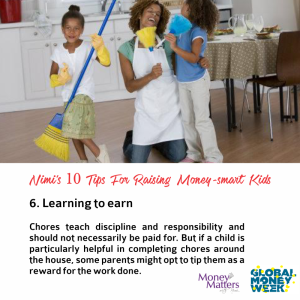
Children and chores

Do you remember having chores that you were responsible for when you were growing up? Were you paid an allowance to do the chores?

I believe that if chores are tied to a monetary incentive, children can decide to opt out of receiving compensation.
In the real world there are roles and responsibilities, if you don’t take responsibility for tasks assigned to you, it is anti social and puts a burden on others. Chores should not be optional; they should be the responsibility of all members of the household. How do you feel about paying for chores?
Here are some advantages of chores:
A SENSE OF RESPONSIBILITY 
When children know that there are certain tasks that must be completed, and well done, gives them a sense of responsibility.
FEELING OF ACCOMPLISHMENT 
When a job is done well, a sense of accomplishment comes with it. Encourage and praise your child when they do well. This boosts self-esteem.
INDEPENDENCE 
When kids learn to complete their chores without being cajoled, they learn early lessons about being independent, capable adults.
TIME MANAGEMENT 
We all juggle various tasks in our lives. Children must juggle family time, homework, chores, extra curricular activities…This develops essential time management skills.
HOUSEHOLD SKILLS 
From making their own beds to helping with laundry, washing the dishes or the car, to cleaning the house or helping with younger siblings are all-important skills for managing an orderly home in future.
TEAMWORK 
Chores introduced and shared within a family in a fun engaging way, develops a sense of teamwork. Helping others to achieve a common goal is a great skill for professional life.
WORK ETHIC 
Learning about hard work is an essential part of becoming a focused, successful adult. When children are held accountable for completing tasks it helps them develop a strong work ethic that will stand them in good stead in future.
If you haven’t yet introduced chores, the weekend is a good time to start!
Kindly drop your comments below.

Are Your Children Ready For The World of Work?

The long holidays have started and some teens and adult children are idle, only watching TV, eating and surfing the internet. After all the happenings in the last year, and the fact that international borders are gradually being open, travel and family time is important. Children also need to rest, catch their breaths and unwind but they don’t need to do that for the entire holiday. Take advantage of the long holiday to add huge value to their future, in preparation for when they start to work.

Grades matter

From a very young age, students are expected to get the best grades possible. This puts so much pressure on our young people. Grades do matter, but remember that they are not everything; having good grades doesn’t necessarily translate into a good job or make you a great employee. There is so much more to life than grades.

Of course, as Nigerian parents, we desire and can be blinded by those A grades, but work experience, an array of extracurricular activities, and interests have become as important as exam or coursework grades in the search for top candidates. A well-chosen internship opportunity often gives students an edge.

Hands-on practical experience

It is on the job that you can truly hone some professional skills and gain hands-on, real-world experience outside the classroom. Theory is important but it comes alive when you are given an opportunity to put that knowledge into practice. This prepares you to go back to school equipped with greater understanding and fresh perspectives on the subject matter, reinforcing classroom concepts.

Interning provides an opportunity for you to work in a team – one of the most essential ingredients for success. This throws up many aspects of character, leadership, collaboration, technical skills, managing deadlines, responsibility etc. It is from this that a sound work ethic can be built.

“An audition in disguise”

An internship can lead to a full-time job at your host company. If you’ve left a great impression that you are hardworking, committed, intelligent, and capable, you are certainly in a more competitive position to be considered than even those with far superior grades since your bosses are already familiar with your work ethic.

Internships give you a foot in the door; this is an ideal way for both employer and intern to test the waters for a period before committing fully. If you’ve impressed them, you’ll probably make the final list even ahead of candidates more accomplished and with stronger credentials than you.

Test the waters

So many young people embark on a path only to find after considerable time and expense, that they wish to change direction. Ideally, it would be nice to know as early as possible where your strengths are and where you will find fulfillment. An internship usually lasts for about 3 – 6 months. This is a great opportunity to test out a job or career path with enough time to learn whether or not it is a good fit without a long-term commitment.

You might also try out various sectors during each vacation; different careers demand varying skill sets. This way, you get a wide range of experience under your belt and can begin to narrow down your choices as you identify your strengths as well as areas in which you feel challenged.

Apart from the formal roles, there are numerous other opportunities to consider; from volunteering and community service, helping at a holiday camp, waiting tables in a restaurant, sales clerk at a local store.

Have you thought of setting up a business?

What are your talents and skills that make you stand out? Have you ever considered the possibility of monetizing them? The long vacation is a great time to explore the possibility of collaborating with others to set up your own business. This really impresses employers.

The family business

If you have some hope of your children eventually joining the family business, the holidays are a good time to have them spend some time learning from you from the bottom of the ladder. Over years, they will become familiar with the ethos and vision of the family business. The mistake many families make is to impose their adult children as Executive Directors with little to no interest or knowledge about the family firm. Far too many family businesses do not survive much beyond the life of the founder.

Relevant work experience

If you already have an idea of the path that you wish to pursue, select a firm in that field that will help equip you to prepare for future interviews and direction by gaining invaluable industry knowledge. Employers tend to choose candidates that have some experience that is relevant to the position they are actually hiring for; this puts you up on the learning curve and helps you settle into a new role with ease.

But keep an open mind; it is useful to expand your horizon; you may just find an area that you might never have considered, that suits you perfectly. Also with the level of unemployment out there, you may well need to just grab a job if you are offered one.

Valuable connections

Professional connections are among the most valuable networks that you can have in your life. Even if you are not retained for a full-time position, the networks that you build from even a short stint can be invaluable whether for providing mentoring and support as you grow or for career advice, references, or recommendations for your next job.

Find a mentor, but remember that a senior colleague is more likely to take interest in an interested, committed, hardworking intern and not someone that is always late, unresponsive, doesn’t meet deadlines, and adds little or no value.

Should money be a factor?

As far as possible, try not to let money be the overarching deciding factor when you are thinking of interning. Gaining useful experience should be your goal for the value it will bring to your resume and your personal life. Of course, for most, it is impossible to accept a role for any length of time, without pay. However, it is a pity to have to turn down an excellent but unpaid internship opportunity, as this significantly limits available opportunities.

Financial responsibility

One of the greatest benefits of interning is earning and learning to manage your own money. Money that you have earned from your own sweat tends to have more meaning than allowances and gifts from parents. Hard work builds discipline and frugality; when you work hard to earn, you are more selective in your spending choices.

Time is a fundamental ingredient of successful investing as funds set aside have time to appreciate in value. This presents a wonderful opportunity to set aside at least part of your income and begin the journey to financial independence. Mutual funds are ideal for small savers with entry as low as N5,000; the key is to be consistent and to think long term.

And a word for parents… encourage your children to earn. Working daily, whether physically or online, is an important step to financial responsibility. It is not the amount of money your child earns, but the lessons learned that count. The sense of independence and accomplishment provides a child with a solid foundation for their development and when they leave home, you will have that knowledge that they are capable, independent and can take care of themselves and their loved ones.

Do You Spoil Your Children?

Parents are generally driven by a natural instinct to love, nurture, and provide for their offspring. Our greatest desire is to give them everything we ever had, or, never had, and more. The danger is that whilst we are deriving pleasure from indulging them, we may actually be spoiling them and interfering with their development thus diminishing their own sense of accomplishment.

One dictionary definition describes spoiling someone as to “overindulge so as to cause to demand or expect too much.” “a spoilt child” – is described as having the character or disposition harmed by pampering or over-solicitous attention.

Interestingly, over 2,000 years ago, the famous Greek philosopher Socrates, made this observation about children of his time. “Children now love luxury; they show disrespect for elders and love to chatter in place of exercise, they no longer rise when their elders enter the room. They contradict their parents, chatter before company, gobble up dainties at the table, cross their legs and tyrannize their teachers.” Doesn’t this sound familiar today?

Many children, particularly young adults are living way above their means. This is not obvious when they are still living at home with a roof over their heads but when they move out, they are often tempted to continue to live an extravagant lifestyle,desperate to acquire possessions they cannot really afford. Such expensive purchases, such as first class travel for a child that has never earned, can be introducing a lifestyle of over-indulgence and debt.

A young adult that sees their parents as a personal bank, and feels no reciprocal responsibility whatsoever, may find it hard to contribute to society. One may be creating adults that feel no obligation to anyone; the implications of this for society,are far reaching.

Are you giving in to your child’s every whim? Some of the consequences of over-indulging children are discussed below.

In a world driven by naira and dollars, easy money, can slowly make children lack the necessary motivation and drive most people need to achieve their goals. In general, it is human nature to take the path of least resistance to achieve goals. When children are deprived of the opportunity to be self reliant, they develop a sense of entitlement that shields them from the need for sheer hard work and motivation. Sadly, they may never reach their full potential, if they constantly have their parents’ largesse at their disposal, as the loss of personal self-sufficiency comes from never having to take care of your own basic needs.

“Easy come, easy go”. We often hear of stories of those who acquire sudden wealth and just as suddenly spend or lose it all. It is psychologically a lot easier to spend money that suddenly arrives on your doorstep than to spend money you have had to work hard to earn.

Children often identify their self worth with the approval of their peers, which could be linked to how many toys they have, or how expensive their clothes are. Parents
must show their children that their true value lies in their inner qualities – their kindness, creativity, compassion, rather than for their looks, performance andpossessions. Unfortunately, the materialistic society that is endemic in Nigeria, fosters attaching self-worth and other peoples’ approval for things such as a fancycar or a house or clothes.

The 21 or 22 year old living beyond their means may not be mature enough to realize the challenges they will face 10 years down the road; They may never have to make ends meet or save up to be able to buy something they value, be it a holiday, or a car. This could leave them financially dependent on their parents in adulthood, when they deserve to be catering for retirement. Children could become victims of paralysing debt with no idea of how to save or budget. On the more sinister side, they can become financially irresponsible and out of desperation, be tempted to maintain a certain lifestyle, without any scruples.

Instead of giving them too much, encourage children to give of themselves to others. You can provide opportunities for them to be caring, giving human beings.Young children can donate their outgrown toys, books and clothes whilst older children and young adults can do volunteer work giving of their time and talent. You want them to keep things in perspective and strive to help those who may be less fortunate. This helps them to better appreciate what they have.

“Children will do what you do, not what you say.” Actions do speak louder than words, so if we set a good example and show restraint and demonstrate the importance of hard work and effort in earning a living, it will impact on our children.If our lifestyle displays obscene extravagance, this also impacts on our children in more ways than we can imagine.

Bringing up children to understand the value of money and of being self-sufficient as they grow from childhood to adulthood is a challenging but rewarding process. If we want our children to grow up to be financially responsible adults, we must teach them to understand the value of money and how to handle it from an early age. They need to understand and practise spending, saving, banking and investing.Teach them that money saved and invested today can create more for tomorrow.

One of the most precious gifts you can give your children is the true independence they gain when they learn to earn a living. When they leave home, you can be confident that you have raised a child that can step out into the world to fend for themselves.

Raising financially literate children

children

Our current educational system focuses almost totally on academic subjects and very rarely is any aspect of money management taught in the school curriculum. This is set to change in due course.

PrintAt an event to mark Global Money Week held at Abuja in March 2014, the Central Bank of Nigeria (CBN) announced that the curriculum that would be used in Nigerian schools to teach the concept of financial literacy would be released next year. Global Money Week is a global money awareness celebration that takes place in March each year to engage children globally regarding the basic concepts of savings and investing.

The CBN in collaboration with the Federal Ministry of Education, the National Education Research Council, as well a financial literacy steering committee including stakeholders in the capital markets, banking, insurance, and pensions industries seeks to ensure that financial literacy is integrated into the Nigerian school curriculum by 2015 to better equip students to manage their finances in adulthood.

Nigeria is not alone in this drive for financial literacy among its youth population. Children will be taught how to manage their money in schools for the first time in England, after financial education was included in the national curriculum towards the end of 2013. The details published by the UK Department for Education includes “financial mathematics.” According to the published curriculum, pupils will learn to manage their money and plan for future financial decisions in citizenship classes, which will also include instruction in financial products and how public money is raised through income tax.

Parents have a role to play in encouraging financial literacy among their children as the most practical and profound lessons are at home. They often ask about the age when they should start teaching children about money, or whether or not they should give their children an allowance or pocket money.

To raise money-savvy children, parents should start to teach from the time a child can count and regularly reinforce money lessons as children grow up. An allowance puts money in your children’s hands and presents and opportunity to introduce budgeting and prioritizing. Opinions vary as to whether or not they should be given an allowance. Some argue state that it gives them unrealistic expectations and develops in them a sense of entitlement to be given money for doing “nothing”.

Some parents go as far as to introduce commission based work for chores. Certain tasks at home are thus assigned naira amounts and if the job is done very well, they are paid. If they don’t do the job well or display a bad attitude are unhelpful then any payment is withheld. One wonders if the payment for chores won’t make children tie monetary compensation to everything that they do.

When your children earn or are given an allowance, help them to divide it into three tiers: saving, spending, and giving. By guiding them through these concepts of saving, spending and giving you’re laying a foundation for their future financial security.

Children can start to learn the virtues of work from a young age. One must make sure that the jobs that they do are age appropriate. Even the youngest children can do minor tasks that keep them engaged and provide useful learning opportunities.

As children get older, they are introduced to debit and credit cards. Indeed, as soon as they arrive at some university campuses, they become the target of financial institutions some of whom are keen to introduce debt very early in their banking relationships. They must be taught the pros and cons of both. If your children become prone to debt from an early age you can be certain that you will be spending much of your retirement years bailing them out of financial difficulties.

Are your children at home on holiday now? This might be one of the best opportunities to put some financial principles their way. Our children tend to imitate our money habits. They see you working hard so why not put them to work for at least part of the long holiday. This provides a valuable lesson that work is how money is earned.

When it comes to earning, saving, spending and giving, try to involve your children as you plan your basic household budget. Take young children to the supermarket with you. Let them watch the process of selecting various items and how much they cost. Let them make some choices to learn what is expensive as compared to what is more affordable.

Discuss with them where money is going and what your priorities are. They should also make their budget and prioritize between their wants, and needs. Sometimes it is difficult to explain things but practical exposure to paying utility and other bills can become powerful learning events. These will be long lasting lessons in how they manage their own money.

We all know how much better off we might have been if we had learned the basics of personal finance when we were much younger. Good money habits, learned early in life can help to insulate children from making mistakes later in life. Why not give your children a head start by introducing some of the principles to them now. They will be so much better for it.

Back To School Tips

As the holiday season draws to a close, parents must consider one of their biggest, recurring costs which is the school fees. Here are some back to school money tips as you prepare for the new session:

Plan
Ideally, parents should have started planning for the school year long before now. When you shop early, you can take advantage of sales and discounts. This is probably the most expensive time to shop for the school year. Indeed, if there are items that your child doesn’t need right away or not for several weeks, then you might wish to wait for when leftover school items are sold at discounted rates.

Budget
Most people cannot afford to buy every item on the school list. How much money do you have to spend? Set out a budget for school supplies including school fees, books, lunch, the school bus, uniforms, allowance, supplies etc. Shop with your list, prioritize and stick to it.

What can you afford?
Today’s harsh economic climate has left thousands of parents struggling to pay for their children’s education. If your child is exceptionally bright and talented, explore opportunities for scholarships and bursaries.

If you have cut back as much as you can, even sold assets, and are still struggling to meet your obligations, it may be time to withdraw from a particular school and seek a cheaper option. The most expensive school whether at home or abroad, is not necessarily the best. Be careful not to jeopardize your livelihood and retirement plans to fund an education you cannot afford.

Review the school list
Review the school list critically. Can any items used last term be used this term? You will be surprised to find that there are many items at home, so you can avoid wasting money or duplicating them.

Don’t look down on “hand me downs”. Naturally, every child would love to have everything brand new each year but where older siblings attended the same school, it makes perfect sense to use hand down uniforms if in good condition, even if you can afford to buy new ones. Some schools offer almost new uniforms; quite frankly, at the rate at which children outgrow clothes, it makes sense to buy some items second-hand.

Reviewing the school list with your child is an opportunity to teach some valuable money lessons. Talk through the difference between wants and needs; this provides strong lessons in costs, prioritizing and budgeting. It is a good idea to go along with them for some of the shopping trips.

Buy in bulk
Buying school supplies in bulk is most effective for households with multiple school-aged children. For single-child families, consider doubling up with others for extra savings on basic supplies. If you buy too much, they may go to waste as they will get lost, lent out, given away, misplaced or just never used.

Choose quality
It is tempting to buy a cheap school bag, lunch box or water bottle, but what may seem cost effective now will just fall apart in no time. It pays to spend more on good quality, sturdy items that are long-lasting. Quality and durability are more important than being trendy or having the “latest” version.
Keeping up with the Jones’ is a major issue in our society.

Children face enormous peer pressure and will interact with children with much more than they have. As a parent, take the time to talk through these challenging social issues to build their confidence.

Foster accountability
This is a good opportunity to teach your children accountability. Sit down with them to make an inventory of all they are taking to school. Keep a list and give them a copy as they leave for school. They should learn to be accountable for their belongings and at the end of the term, should be expected to bring them back home largely intact. When they return, tick off items together as they unpack. Some items in good condition can still be used the following term. Give a small reward for outstanding care of personal belongings; such incentives have a way of reinforcing messages.

Extra-curricular activities
Extra-curricular activities help children develop and nurture their skills and talents. But your child cannot take part in every activity; there must be some balance to ensure that they are not under undue pressure. Most family budgets cannot afford more than one or two extras; select their favorite activities or those that they are showing interest in, and look for cheaper options outside school, particularly during the holidays.

Health is crucial
Before your children go back to school, a general health check is important – eyes, teeth, general health to avert any festering problems. The premium on a family medical and dental insurance plan is a small price to pay to ensure that they have access to the best medical care. For day students, homemade meals are more nutritious than the fast-food alternatives, so do make this a priority for their daily lunch.

Car-pooling
Look into the option of car-pooling for the daily school run as well as for extracurricular school activities, after school events or sports practices. With car-pooling, parents take turns in taking children to the same school with huge savings on fueling and running costs as well as freeing up some time from the hectic school run.

For boarders, car-pooling is also a good option for exeats, visiting days and holidays. Plan in advance to draw up a schedule with other parents and share the journey to cut costs on long-distance travel.
As with any important long-term goal, careful planning in advance is essential. This reduces the pressure and makes giving the legacy of education a pleasure and not a chore.

Uncovering your child’s talent

We all have God-given gifts or talents and our children are no different. What is your child good at? What does your child love to do? What does your child gravitate towards? What do friends and relations refer to when they talk about your child? All children have an ability that sets them apart if only we can identify it early. What is it?

Does your little girl have a heavenly voice and stage presence? Does your son have a knack for creative writing or playing the piano? Does your child make people laugh? Is he or she precocious? Are they 5 going on 55? Talent can appear in so many different forms, but usually needs a parent to be proactive and focused about drawing it out.

WhatsApp Image 2019-02-22 at 13.37.48(2)

Be observant

If your child naturally picks up a paint-brush or always gravitates towards the piano, is always singing or performing acting skits for the family, or does maths tests just for fun, you could be on to something. They may even be terrible at it for the moment, but be patient!

Provide opportunities

A talent or skill needs opportunities to flourish or it will remain supressed during the formative years; after this special time it may be too late for it to be developed to its full potential. By providing opportunities, your child’s talent can blossom. Introduce different experiences and activities at home; chess, piano, coding, photography, painting, etc. Extra curricular activities in school provide some great opportunities and should be a consideration in your choice of a school.

Praise and encourage

Yes he makes a mess with the paint brush, or she burns all the cookies but is not deterred and still wants to bake. Show how proud you are of the effort. Praising effort not only nurtures your child’s talent but it also builds their self-esteem and makes them want to do even better. Show their talent off to God Parents, friends and relations, (if it doesn’t embarrass them; it usually does!). It can be a little tedious and off putting for a child, if you are the only one involved. School teachers are often great allies, as they provide easy openings to showcase talent.

WhatsApp Image 2019-02-22 at 13.37.48(1)

Invest in the talent

After some pain, tears, and time, you just know in your gut that this may be something really special. For serious development, try to broaden your child’s understanding of their craft or subject. It will take some investing in equipment, private tuition, holiday camps, etc. This will guide and inspire them If she is a budding actor, take her to theatre productions, if it’s swimming, to local and even international meets. Open all the doors you can whilst giving equal focus to academic work; it will always matter.

Enter Competitions

Competitions are a great way of further developing a talent or skill. The preparation for a significant competition naturally requires more practice and focus. Other benefits are the performance experience, getting noticed through exposure to a wider audience, feedback from experts, scholarship and new opportunities for further performance.

It’s not about you

Don’t force your own passion onto your child. Just because you were in the First 11, doesn’t mean your child will be in the Olympics. Of course it can be heart breaking if you’ve been boasting or showing off about your child’s prowess in gymnastics or the double bass, and they want to give it up! Imagine your little girl, the star ballerina in her pink tutu; in your mind you can already see her as the principal dancer in “Swan Lake” at London’s West End someday; she then throws it all away to join the school wrestling team!

Is your child enjoying it?

Your child will not enjoy it all the time. This is where your patience can be really tested. You might need to force things for a while, but before it becomes too much, it might be worth taking a break for a period and re-introducing with a gentler approach. Be careful; this is where many children drop an instrument or a sport permanently. By pausing an activity, your child might realise they actually miss it. On the other hand they may discover something totally different, that they love with a passion and wish to pursue.

Be mindful of pressure

As parents (especially Nigerian parents) we can load our children’s schedules with far too much activity; multiple classes, practices, sports meets, competitions etc. Too much pressure can be negative. Children do need time to just be or to simply explore. Structure does have its place, but it is through experiencing different things that a child’s interests will emerge. They do need down time to rest or do nothing. With greater awareness about mental illness we must be conscious of the strong link with the excessive pressure in this competitive world that our children face. Lets not add to it.

5 WAYS TO TEACH YOUR KIDS TO BE ENTREPENEURS

“The National Company of the Year Competition 2016 is an opportunity for us to showcase the weight of potential that lies within these young minds and JAN’s role in grooming the next generation of leading entrepreneurs. This is a call-to-action for corporate stakeholders, teachers, youths, entrepreneurs and all who support the cause of empowering youths to become not just leaders but, conscientious leaders leading a vibrant economy.”
Mrs. Efua Edeh, Executive Director, JAN

_____

I am very honoured to have been invited by Junior Achievement Nigeria (@janigeria) to be a judge at the competition this morning.
The NCOY winner will represent Nigeria against other JA Africa member-nation companies for the title of JA Africa Company of the Year in Zimbabwe this December.

_____

It’s never too early to introduce your kids to entrepreneurship by fostering “Kidpreneurs.”

1. ALLOW KIDS SPACE TO BRAINSTORM

Some of the best products came from wild ideas, so don’t put your parental brain limitations on your kids, let them dream big.

2. COACH THEM ON GOAL SETTING

So that they have big dreams and ideas, show them how to formalise those goals with a paper and pencil, or typed out on their tablet. Focused goal setting teaches accountability

3. SUPPORT THEIR SUCCESSES, BUT MORE IMPORTANTLY, REDIRECT THEIR FAILURES INTO SEEING NEW OPPORTUNITIES

Entrepreneurs think different. Coach them when they fail or have set-backs to always bring a set of optimistic eyes to the issue to find opportunity.

4. INTRODUCE THEM TO A BUSINESS

Starting Your Kidpreneur writing their first businessplan now may sound extreme, however a simple outline will help them learn structure.

5. INVEST IN THEM

Support your kids startup dreams by investing in them. Don’t just give them money, assign dollar amounts for extra jobs your kids could help with around the house, go over the parameters just like a client and at the end, review their service. (From kidpreneur.org)

“Youth who are taught about entrepreneurship show a positive change in attitude and strong success orientation, and are more likely to be focused on academic and professional achievements, aspirations and leadership.”

The Harvard Graduate School of Education

Teach Your Children About Money

WhatsApp Image 2018-05-17 at 12.30.51 PM

I was about 5 years old but I still remember because it was one of the hardest decisions I had to make . I had just done my monthly job of cleaning shoes and been paid by my father a whopping salary of N100 including all the debt he owed !!! My life was complete! But my joy was short-lived because that night armed robbers visited our ‘little mansion’ stealing everything .

I remember running to my room after they left and we had come out of hiding ‍♀, searching frantically . Finally, I found it ,my N100, neatly tucked in my pillow case , they hadn’t found it ! I was ecstatic !!!

Then I thought about my father who had lost everything. I remember sitting on my bed, #deflated .

So I made a decision..a very difficult one, one that broke my heart but needed to be done .

I walked up to him as he sat in his chair brooding , handed him my N100 and said ‘We are now poor but you can have this back since you don’t have any more money.’

You see that N100 was my riches , BUT it wasn’t his . .

So He smiled, told me to keep it then explained that what was in the house wasn’t the sum total of his wealth, it was just what could be seen. He had more in a place called ‘The Bank’ and other places . That was the beginning of my financial education.
From that day I was taught by my father who was a financial consultant , about money, how to multiply it , where to keep it, what to do when you lost it, how to create it and how to never be rendered helpless by it.

Don’t shield your children from the realities of life especially as it concerns money. Train them on it , good decisions, bad decisions , why you are broke , what you should have done better. You do not need to spell out everything but give them a bird’s eye view…trust them with knowledge .
They are making assumptions as they go on-Direct their learning ,even when it means admitting you failed.

Don’t just make up your mind to provide all their needs, train them enough that when the time comes they can provide their own needs .

Some of the money problems we face as adults is directly related to our lack of financial instruction as children.
#DontRepeatTheCycle.

My Daddy Is Richer Than Yours

“What we must decide is perhaps how we are valuable, rather than how valuable we are”
– Edgar Z. Friedenberg 1959

Anna Jahns in “Spoiling Childhood” discusses how parents today are often “caught up in a guilt driven pendulum, swinging between parenting too little and parenting too much to compensate” for other deficiencies in their parenting. Well-meaning parents are giving their children too much of what they want, but perhaps not necessarily what they need.

Parents are driven by a natural instinct to love, nurture, and provide for their offspring. We all want to see our children blissfully happy and our greatest desire is to give them everything we ever had, or, never had, and more. This desire can push us to spoil them. The danger is that whilst we are deriving pleasure from overindulging them, we may actually be interfering with their development and diminishing their own sense of accomplishment.

One dictionary definition describes spoiling someone as to “overindulge so as to cause to demand or expect too much.” “a spoilt child” – is described as having the character or disposition harmed by pampering or over-solicitous attention.

Interestingly, over 2,000 years ago, the famous Greek philosopher Socrates, made this observation about children in his time. “Children now love luxury; they show disrespect for elders and love to chatter in place of exercise, they no longer rise when their elders enter the room. They contradict their parents, chatter before company, gobble up dainties at the table, cross their legs and tyrannize their teachers.”

Doesn’t this sound like far too many Nigerian children today?

Many children, especially young adults are living way above their means. This is not obvious when they are still living at home with a roof over their heads but when they move out, they are often tempted to continue to live an extravagant lifestyle, desperate to acquire possessions they cannot really afford. Such expensive purchases, or first class travel for a child that has never worked for one day, depending upon the child, can be introducing a lifestyle of debt.

Children can turn out to be manipulative and calculating, blatantly taking parents for granted. A young adult that sees their parents as a personal bank, feels no reciprocal responsibility whatsoever, may find it hard to contribute
to society. One may be creating adults that feel no obligation to anyone; the implications of this for society, are far reaching.

The greatest gift of love we can give our children is to value them for who they are. When children have love and affection, respect, attention and unconditional acceptance, the sense of self that this develops in them stretches way beyond what giving in to every material demand can achieve. Perhaps we should search ourselves; if you find yourself giving in to your child’s every whim, try to check yourself to find out whether it is you that has a need to fill in your own life.

DANGERS OF SPOILING CHILDREN MATERIALLY

Some of the consequences of over-indulging children are discussed below. Lack of motivation and drive in a world driven by naira and dollars, easy money, can slowly make children lack the necessary motivation and drive most people need to achieve their goals. In general, it is human nature to take the path of least resistance to achieve goals.

When children are deprived of the opportunity to be self reliant, they develop a sense of entitlement that shields them from the need for sheer hard work and motivation. Sadly, they may never reach their full potential, if they constantly have their parents’ largesse at their disposal, as the loss of personal self-sufficiency comes from never having to take care of your own basic needs.

Spendthrift lifestyle “Easy come, easy go”. We often hear of stories of those who acquire sudden wealth and just as suddenly spend or lose it all. It is psychologically a lot easier to spend money that suddenly arrives on your doorstep than to spend money you have had to work hard to earn.

Equating Self worth with Net worth Children often identify their self worth with the approval of their peers, which could be linked to how many toys they have, or how expensive their clothes are. Parents must show their children that their true value lies in their inner qualities – their kindness, creativity, compassion, rather than for their looks, performance and possessions. Unfortunately, the materialistic society that is endemic in Nigeria, fosters attaching self-worth and other peoples’ approval for things such as a fancy car or a house or clothes.

Stories abound of children asking to be dropped off before the school gate so that their peers won’t see the car they came in. If it’s not an expensive car or jeep, it could be embarrassing. Their friends jeer, “my daddy is richer than yours”. A Nigerian parent once went to pick his child at a British boarding school in a helicopter – not the norm. The poor child barely survived the teasing that followed that display.

In an excerpt from The Vanishing Adolescent 1959, Edgar Z. Friedenberg writes, “What we must decide is perhaps how we are valuable rather than how valuable we are”.

We must teach our children to be proud of whom they are, to value themselves and not to confuse their self worth with their net worth.

Financial dependency

The 21 or 22 year old living beyond their means may not be mature enough to realize the challenges they will face years down the road; They may never have to make ends meet or save up to be able to buy something they value, be it a holiday, or a car. This could leave them financially dependent on their parents in adulthood, when they deserve to be catering for retirement. Children could become victims of paralyzing debt with no idea of how to save or budget. On the more sinister side, they can become financially irresponsible and out of desperation, be tempted to maintain a certain lifestyle, no matter what.

SOME TIPS TO ENCOURAGE GOOD MONEY VALUES

Teach them to give of themselves instead of giving them too much, encourage children to give of themselves to others. You can provide opportunities for them to be caring, giving human beings. Young children can donate their outgrown toys, books and clothes whilst older children and young adults can do volunteer work giving of their time and talent.

You them to keep things in perspective and strive to help those who may less fortunate. This helps them to appreciate what they have. Be a good role model “Children will do what you do, not what you say.” Actions do speak louder than words, so if we set a good example and show restraint and demonstrate the importance of making an effort to earn a living, it will impact on our children. If our lifestyle displays obscene extravagance, this also impacts on our children in more ways than we can imagine. An anxious head teacher mentioned to me that in her school some children bring in wads of N500 notes to distribute to their friends hoping to gain friendships in this way. Perhaps they are witnessing money being doled out at home in this way.

Teach them about money early in their lives. Bringing up children to understand the value of money and of being self-sufficient as they grow from childhood to adulthood is a challenging but rewarding process. If we want our children to grow up to be financially responsible adults, we must teach them to understand the value of money and how to handle it from an early age.

They need to understand and practice spending, saving and investing, and banking. Encourage them to earn from their early years. One of the most precious gifts you can give your children is the true independence they gain when they learn to earn a living. When they leave home, you can be confident that you have raised a child that can step out into the world and fend for themselves. Both allowances and chores can play a role here. Allowances can teach money management: how to earn, save, budget, and prioritize purchases, whilst chores can teach cooperation and responsibility.

My siblings and I were always obliged to put any talents we had to use in the holidays or find holiday jobs; we were never allowed to spend an entire holiday “loafing” around the house as my father called it. Our jobs ranged from providing home-baked rock buns to Chanrai’s Supermarket, reading the news at a local radio station, working as a shop assistant, helping to prepare stage sets for Cultural Centre plays, to giving piano lessons. I have noticed that my children are much more disciplined and careful with their own hard earned money than they are with their “free” pocket money or allowance.

Lets consciously take time out to examine the values we are imparting to our children. I urge you not to deplete your retirement savings by over-indulging them even where they are pleading for excesses. Teach them that money saved today can create more for tomorrow.